Introduction: Why Mooring Buoys Matter More Than Ever
In the vast, ever-shifting expanse of the ocean, keeping a vessel exactly where you want it is both an art and a science. For centuries, sailors relied solely on anchors dropped to the seabed — a method that works well enough in calm, shallow waters, but quickly reveals its limitations in deep-water ports, sensitive marine ecosystems, and high-traffic offshore installations. Enter the mooring buoy: one of the most deceptively simple, yet critically engineered components in the entire maritime industry.
A mooring buoy is a floating device anchored to the seabed that allows vessels to secure themselves without deploying their own anchors. For marine engineers, port authorities, offshore operators, and environmental managers, understanding mooring buoys isn’t optional — it’s foundational. Whether you’re designing a deepwater terminal, managing a marine protected area, or specifying equipment for a new offshore wind farm, your understanding of mooring buoy systems directly impacts safety, operational efficiency, and environmental compliance.
This guide covers everything you need to know: the physics and engineering behind mooring systems, the different buoy types and their applications, installation methodologies, regulatory frameworks, maintenance protocols, and the innovations reshaping the industry. By the end, you’ll have a thorough, practical understanding of mooring buoys that you can apply directly to real-world maritime challenges.
What Are Mooring Buoys? A Technical Overview
At their most fundamental level, mooring buoys serve as intermediary anchoring points between a vessel and the seabed. Unlike traditional anchoring where the ship’s own anchor chain contacts the bottom, a mooring system transfers the holding load to a pre-installed, engineered ground tackle arrangement. The buoy itself is the visible, floating interface — but it’s the system beneath the surface that does the real work.
The Basic Components of a Mooring System
A complete mooring buoy system is composed of several interconnected elements, each engineered to handle specific loads and environmental conditions:
- The Buoy Body: Typically constructed from high-density polyethylene (HDPE), steel, or fiberglass, the buoy body provides the buoyancy that keeps the system afloat and visible. Its size and buoyancy rating are calculated based on the expected vessel displacement and mooring line tension.
- The Mooring Pendant: The pendant is the line or chain connecting the vessel to the buoy. It must be sized to handle dynamic loading — not just static weight, but the surge, sway, and yaw forces generated by waves, currents, and wind.
- The Ground Tackle: This is the subsurface anchoring arrangement — chains, swivels, shackles, and the primary anchor or anchor pile that transmits load to the seabed. Ground tackle design is where marine geotechnical engineering intersects with mooring system design.
- The Riser Chain: Connecting the seabed anchor to the buoy body, the riser chain is subjected to constant cyclic loading and must be rated for fatigue as well as static tension.
- Swivels and Shackles: These connecting hardware elements allow rotation and articulation within the system, preventing chain twist and reducing peak loads during vessel movement.
Understanding these components as a system — not as isolated parts — is what separates competent mooring system design from truly reliable engineering.
Types of Mooring Buoys and Their Applications
Not all mooring buoys are created equal. The industry uses a diverse range of buoy types, each optimized for specific environments, vessel classes, and operational requirements.
Single Point Mooring (SPM) Buoys
Single Point Mooring buoys are among the most sophisticated mooring systems in the world. Used predominantly in the offshore oil and gas industry and at large liquid bulk terminals, SPM systems allow Very Large Crude Carriers (VLCCs) and other supertankers to moor in open water, load or offload cargo, and weathervane freely around the mooring point in response to changing wind and current directions.
There are several subtypes within SPM technology:
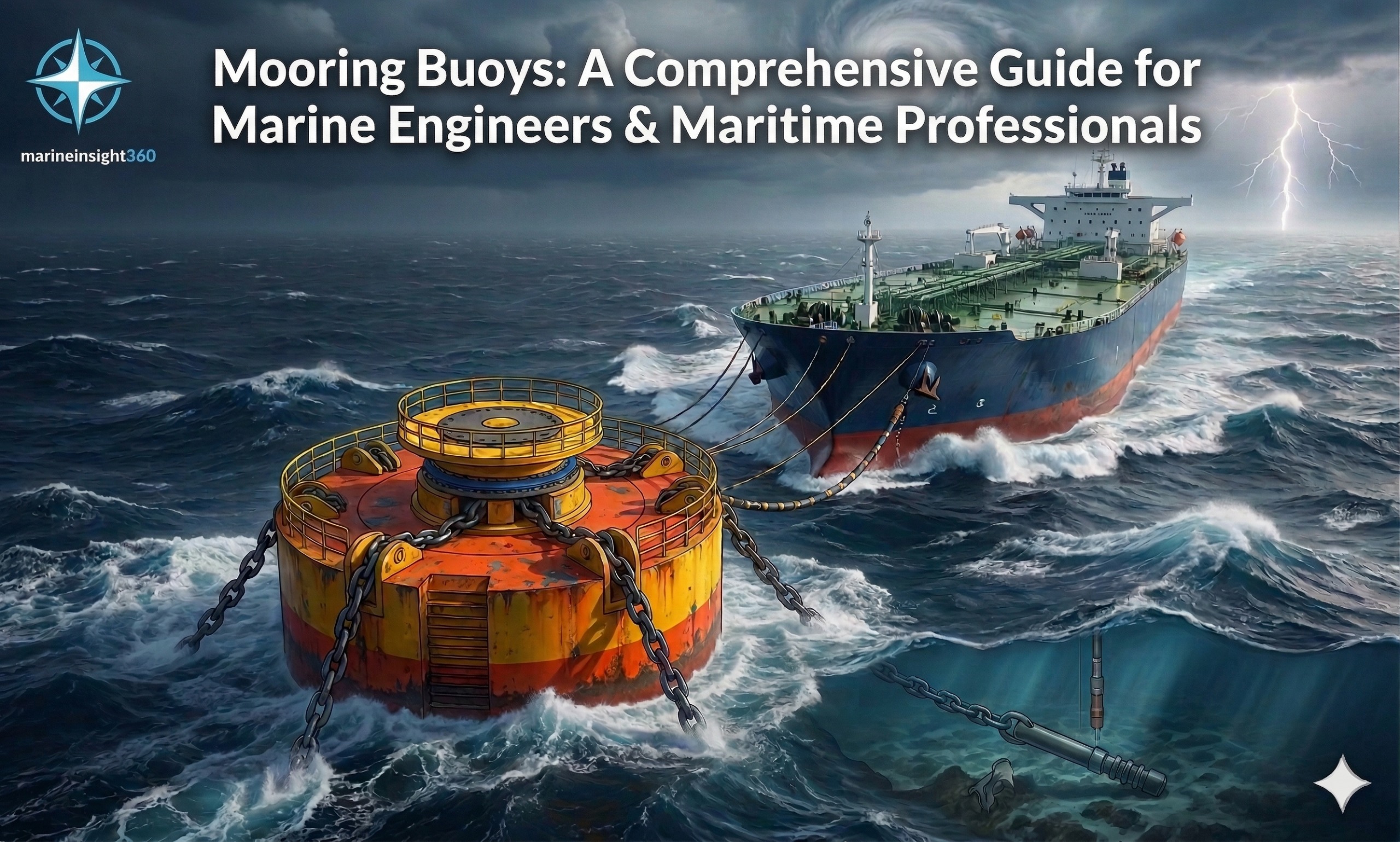
Catenary Anchor Leg Mooring (CALM): The CALM buoy is the workhorse of offshore terminal operations. It consists of a large buoy body, typically 8–16 meters in diameter, anchored to the seabed by multiple catenary chain legs. A central turntable allows the buoy to rotate, while fluid swivels enable continuous cargo transfer through a floating hose string even as the tanker weathervanes.
Single Anchor Leg Mooring (SALM): Unlike the CALM system’s multiple catenary legs, the SALM uses a single vertical anchor leg — either a chain or rigid yoke — terminating at a universal joint on the seabed. This design is better suited to locations where seabed real estate is limited or where the current regime favors a near-vertical mooring load.
Turret Mooring Systems: While technically an internal vessel system rather than a standalone buoy, turret moorings integrate SPM principles directly into FPSO (Floating Production, Storage, and Offloading) vessels. The turret is effectively a built-in mooring buoy that allows the entire vessel to weathervane.
Conventional Mooring Buoys
Conventional or “standard” mooring buoys are the type most commonly encountered in harbors, anchorages, and marine reserves. These systems typically consist of a spherical or cylindrical float connected to a chain running down to a concrete clump weight, a driven pile, or a deadweight anchor on the seabed.
These buoys are used for:
- Commercial vessel mooring in ports where alongside berths are unavailable
- Recreational vessel mooring in protected anchorages and marinas
- Environmentally sensitive areas where dropping a vessel anchor would damage seagrass beds, coral reefs, or other benthic habitats
Conventional mooring buoys are classified by their holding capacity, typically expressed in tonnes. Specifying the correct holding capacity requires analysis of the vessel characteristics (LOA, beam, displacement, windage area) combined with the environmental design conditions (wind speed, current velocity, wave height) for the specific site.
Marker and Hazard Buoys
While not primarily designed for vessel mooring, marker buoys and hazard buoys are an essential part of the broader buoyage system that marine engineers must understand. IALA